
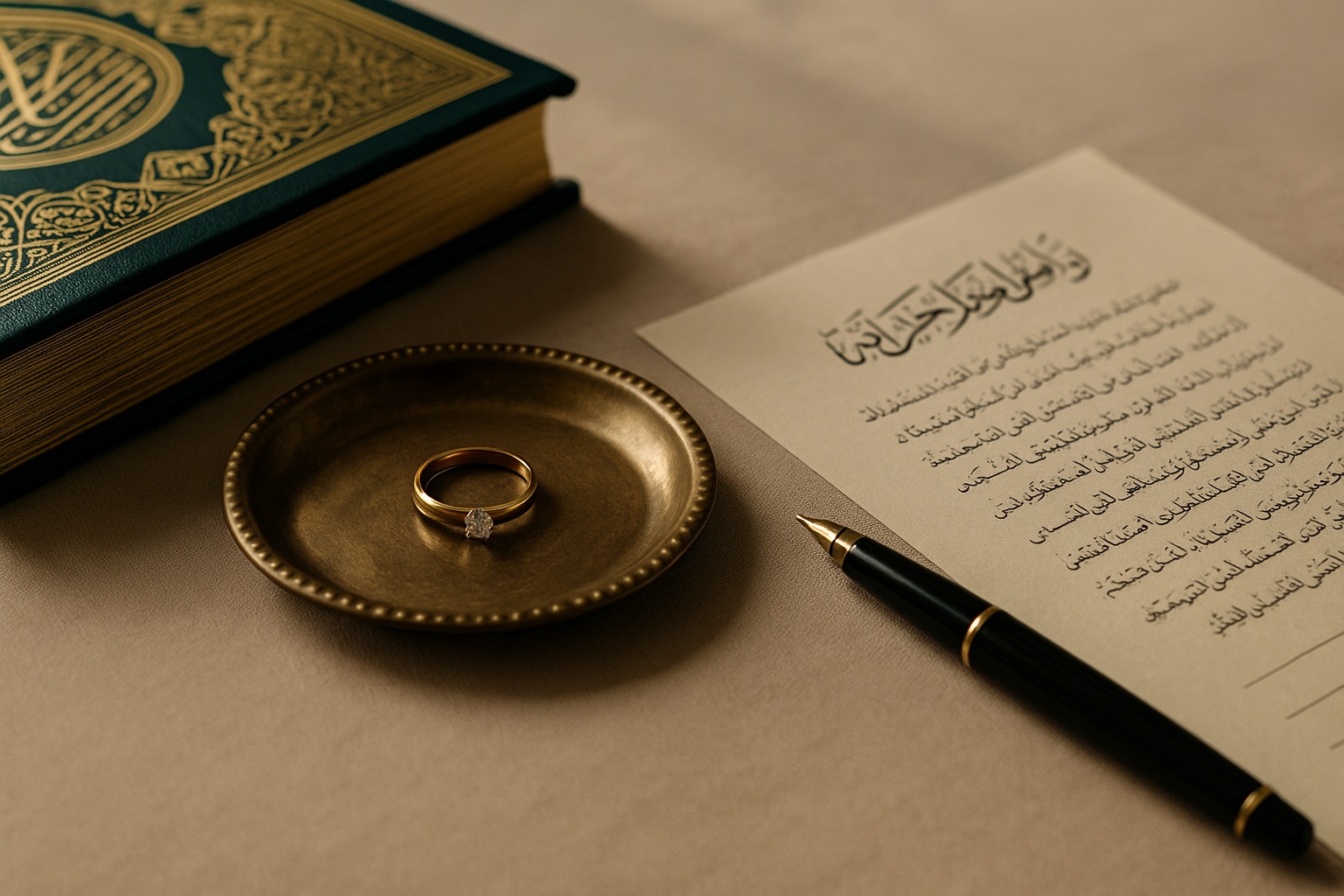
Mahr Explained Simply: Setting a Fair, Halal Dowry Without Awkwardness
“And give the women their dowries graciously.” (Qur'an 4:4) This concise divine directive (āyah 4:4) establishes mahr (also called ṣadaq) as an honorable gift—not a purchase price, not a bargaining chip, but a token of respect and responsibility. Yet many seekers of nikah still find the subject tense, culturally inflated, or confusing. This guide removes anxiety by outlining clear Islamic principles, practical steps, and ethically balanced scenarios so you can approach mahr with serenity, justice, and barakah.
1. Purpose of Mahr: Honor, Security & Barakah
Mahr affirms dignity and acknowledges the bride’s distinct rights. Classical jurists (fuqahā’) describe it as a symbolic entitlement that becomes the wife’s exclusive property upon contract (nikah) or consummation depending on terms. It is neither a price tag nor a measure of worth—Rasūlullah ﷺ married off companions with simple mahr values (sometimes an iron ring, sometimes teaching Qur’an). This prophetic minimalism emphasizes intention (niyyah) and ability (istiṭā‘ah), discouraging ostentation (takalluf). Correct framing transforms negotiation from tension to collaboration: What amount meaningfully honors the bride, reflects the groom’s present capacity, and avoids hardship? When that question guides the process, the outcome supports tranquility (sakinah) instead of debt or resentment.
Qur'an 4:4: “Give the women their dowries graciously (niḥlah).”
Qur'an 2:236–237 highlights leniency and kindness when part or all of mahr obligations adjust due to divorce prior to consummation—reinforcing mercy over rigidity.
2. Scriptural Basis & Core Conditions
The four essentials regarding mahr drawn from Qur'an and Sunnah: (1) It is obligatory upon the groom; (2) It becomes the wife’s property, free of guardians’ control; (3) It must be lawful (ḥalāl) and definable; (4) Excessive burden contradicts prophetic guidance encouraging ease. A well-cited narration relates that the Prophet ﷺ said: “The best marriage is that which is most easy (in mahr).” (Reported in several collections with supporting chains). Scholars caution: low does not mean trivial; high does not mean superior. Valid forms include money, gold, service of a lawful nature, or teaching beneficial knowledge (as in the ḥadīth where teaching Qur’an constituted mahr). Ambiguity (jahālah) should be minimized: specify amount, form, timing (prompt vs deferred), and any deferred maturity conditions in the written contract. Explicit clarity prevents post‑nikah disputes and sustains trust between spouses and families.
3. Types of Mahr & Timing (Prompt, Deferred, Split
Prompt (mu‘ajjal): Paid at or immediately after the nikah session; fosters immediate security for the bride. Deferred (mu’akhkhar): Due at a later agreed event (e.g., after moving in, or upon divorce—serving as delayed protection). Split structure: A portion upfront, remainder postponed—common in cross-border marriages to ease liquidity constraints. Whichever form is chosen, the documentation should: (a) list amounts distinctly; (b) state currency (and conversion benchmark if international); (c) outline triggers for deferred payment; (d) clarify method of settlement (bank transfer, gold weight, educational commitment). Avoid vague clauses like “remainder later” without quantification. If gold is used, specify grams and purity (e.g., “20g 22K”). For non-monetary mahr (teaching skill), define scope (e.g., “20 lessons of tajwīd, weekly”). Precision honors both prophetic clarity and modern legal enforceability.
4. Determining a Fair Mahr
Fairness balances custom (‘urf), groom’s real capacity, and bride’s dignity without extravagance. Consider: (1) Local median mahr range (not the top 5% luxury tales); (2) Groom’s stable income after zakat, debts, essentials; (3) Bride’s context (education, age, relocation impact); (4) Simplicity ethos (avoid making mahr a competition). Islamic legal maxim: “Hardship begets facilitation.” If insisting on a figure pushes the groom toward interest-bearing loans, redirection is advisable. Families can frame a tiered structure: a meaningful prompt gift + modest deferred sum + non-monetary component (e.g., memorizing certain surahs together). Encourage transparent spreadsheets: monthly net income, obligations, planned savings, and an amortization path for any deferred portion. In multicultural marriages, align on currency volatility (e.g., pegging value to gold grams to protect against inflation). A fair mahr fosters gratitude; an inflated one risks quiet resentment and delays marriage.
5. Practical Negotiation Steps & Etiquette
Step 1 – Intention Reset: Both sides reaffirm that barakah matters above status signaling. Step 2 – Information Sharing: Groom prepares a truthful financial snapshot; bride clarifies priorities (security, symbolic gift, education support). Step 3 – Range Establishment: Bride’s guardian proposes a reasonable interval, not a single rigid number. Step 4 – Iterative Dialogue: Adjust based on capacity evidence; avoid public pressure or social media comparisons. Step 5 – Written Draft: Record prompt/deferred amounts, form, schedule, and contingency triggers. Step 6 – Scholar Review (optional): A qualified local scholar validates Sharia compliance and fairness. Step 7 – Heart Check: Prospective spouses privately assess feelings of fairness and willingness. Throughout, uphold prophetic adab: no sarcasm, shaming, or boasting. If discrepancy arises (family desire vs groom capacity), pause for istikhārah rather than escalating tension. Document final agreement with signatures plus two witnesses, then store digitally and physically. Kindness in negotiation becomes a seed for harmonious post-nikah cooperation.
6. Common Mistakes & Cultural Excesses to Avoid
Inflation by Comparison: Quoting celebrity or diaspora figures disconnected from local economics. Hidden Expectations: Unwritten side gifts (luxury car, apartment) not recorded—breeding future bitterness. Symbolic Misunderstanding: Treating mahr as bride’s ‘price’ or family compensation misrepresents its Qur’anic ethos. Delay Tactics: Using deferred mahr to postpone real commitment instead of a genuine schedule. Gender Pressure: Mocking moderate mahr as ‘cheap’ ignoring the prophetic praise of ease. Cultural Add-ons: Layering lavish ceremony demands effectively turning marriage into a debtor arrangement. Ambiguity: Stating ‘gold set’ without weight; ‘USD later’ without date; or ‘education’ without duration. Each erodes clarity and trust. Replace status-driven language (“people will talk”) with principle-driven framing (“Allah has commanded gracious giving”). Families that internalize the mercy embedded in āyāt regarding dowry disagreements can pivot from contest to collaboration.
7. Handling Deferred Mahr (Documentation & Integrity)
Deferred mahr enforces long-term responsibility but only if documented with enforceable clarity. Include: (1) Exact amount or gold grams; (2) Due date or triggering event (e.g., completion of immigration process, first anniversary); (3) Late fulfillment clause—encouraging timely payment without punitive usury; (4) Acknowledgment of partial payments with dated receipts. Store signed originals and secure digital copies (encrypted cloud + local). Schedule calendar reminders. If circumstances change (unexpected medical hardship), renegotiate transparently rather than silently defaulting. The moral weight remains even where civil courts may not enforce. Integrity here becomes a living testimony of the groom’s taqwā and reliability—reinforcing mutual trust.
8. Sample Mahr Scenarios
Scenario A (Minimalist Barakah): Prompt: Memorization support + curated Mushaf + 5g 22K gold. Deferred: 5g more after first Ramadan together. Rationale: Emphasizes knowledge and manageable value. Scenario B (Balanced Urban Professionals): Prompt: $1,500 equivalent + 15g 24K gold ring. Deferred: $2,000 indexed to gold price payable at first anniversary or earlier upon request. Rationale: Honors dignity without debt. Scenario C (International Relocation): Prompt: Flight & settlement allowance $2,500 + Islamic studies course fee. Deferred: $5,000 (or 50g gold) upon successful residency status. Rationale: Addresses relocation cost and long-term security. Scenario D (Mixed Monetary & Non-Monetary): Prompt: $800 + groom teaches tajwīd course (30 sessions). Deferred: $1,200 in two equal installments over 12 months. Rationale: Integrates spiritual enrichment with moderate financial outlay. Each scenario illustrates flexibility anchored in fairness, clarity, and sincerity.
9. Aligning Expectations Early
Expectation alignment should occur before emotional momentum makes compromise feel like loss. Encourage prospective spouses to journal personal must‑haves vs. flexibles, then overlay them in a values conversation—framing mahr among broader marital readiness factors (deen, character, financial planning, future vision). Incorporate istikhārah dua for internal calm. If there is persistent mismatch (e.g., bride’s family insists on figure exceeding groom’s debt-free capacity), treat this as a compatibility or timing issue, not a negotiation ‘failure.’ Transparent early discussions minimize post‑contract regret. When satisfaction, clarity, and mutual respect converge, the agreed mahr becomes a unifying symbol of trust—rather than a figure to be recited mechanically at the nikah.
10. Closing: From Principle to Practice
Approaching mahr through Qur'anic mercy and Prophetic moderation transforms a potentially awkward subject into a spiritually uplifting collaboration. Revisit core pillars: gracious giving (4:4), avoidance of hardship, clarity in documentation, and prioritizing inner readiness over public display. Let your agreement reflect who you aspire to be as spouses: transparent, equitable, and God-conscious. Final checklist: clear amount(s), lawful form, timing defined, witnesses, no hidden conditions, recorded & accessible, hearts content. When these boxes are ticked, proceed confidently to the broader stages of marriage preparation—character refinement, family integration, and shared future planning. For expanded guidance on structuring a complete Islamic marriage journey, see our resource hub at Islamic Halal Marriage Guidance. May Allah place sakīnah, mawaddah, and raḥmah in your union and bless your agreed mahr as a source of mutual goodwill.
Disclaimer: This educational article summarizes mainstream Sunni scholarly perspectives. Local legal requirements or differing madhhab opinions may apply; consult a qualified scholar for specific cases.
Leave a Comment